
Exploring Geometry: Real-Life Applications and Examples

real life applications and examples

Geometry is often regarded as a branch of mathematics that deals with shapes, sizes, and the properties of space. While it might seem abstract at first, the principles of geometry have numerous real-life applications that we encounter every day. From architecture to art, from navigation to technology, geometry plays a vital role in understanding and shaping our world.

In this blog, we’ll delve into some fascinating real-life applications of geometry, accompanied by examples that illustrate its significance in various fields.

Architecture and Design

One of the most obvious applications of geometry is in architecture and design. Architects rely on geometric principles to create structures that are not only aesthetically pleasing but also structurally sound. From the symmetry of a building’s facade to the calculations involved in determining load-bearing capacities, geometry is fundamental to the entire design process.

Example: The Parthenon, an ancient Greek temple dedicated to the goddess Athena, is a stunning example of geometric precision in architecture. Its columns are not only perfectly spaced but also slightly curved to give the illusion of straight lines. The dimensions of the Parthenon follow the principles of the golden ratio, a geometric proportion often found in nature and revered for its aesthetic appeal.

Engineering and Construction

Engineers heavily rely on geometry when designing and constructing various infrastructure projects, such as bridges, tunnels, and roads. Understanding geometric concepts like angles, symmetry, and proportions is essential for ensuring the safety and functionality of these structures.

Example: Suspension bridges, like the Golden Gate Bridge in San Francisco, showcase the intricate use of geometry in engineering. The catenary curve, a natural shape formed by a hanging chain, is employed to design the cables that support the bridge deck. By understanding the geometry of forces and tensions, engineers can create stable and durable structures capable of withstanding immense loads.

Art and Design

Geometry has long been a source of inspiration for artists and designers. From the intricate patterns of Islamic art to the geometric abstraction of modern art movements, geometric shapes and principles are ubiquitous in artistic expression.

Example: The work of Dutch artist Piet Mondrian is a striking example of geometric abstraction. Mondrian’s compositions feature primary colors and straight lines arranged in perpendicular and parallel configurations. His use of geometry reflects a quest for universal harmony and order, transcending mere representation to evoke deeper philosophical concepts.

Navigation and Cartography

Geometry plays a crucial role in navigation and cartography, the science of mapmaking. By understanding geometric principles like angles, distances, and coordinates, cartographers can accurately represent the Earth’s surface on maps and charts.

Example: The Mercator projection, developed by Flemish cartographer Gerardus Mercator in the 16th century, revolutionized navigation by preserving angles and shapes across the map. While it distorts the size of landmasses at higher latitudes, the Mercator projection remains invaluable for navigators because it represents lines of constant compass bearing as straight lines.

Technology and Innovation

In the digital age, geometry is at the heart of computer graphics, animation, and 3D modeling. From video games to virtual reality simulations, geometric algorithms and techniques enable the creation of immersive virtual worlds and realistic simulations.

Example: Computer-aided design (CAD) software, such as AutoCAD and SolidWorks, relies on geometric modeling to create precise representations of objects and structures. Engineers and designers use these tools to visualize, analyze, and iterate on their designs before fabrication, saving time and resources in the product development process.

Conclusion

Geometry is not just an abstract branch of mathematics; it’s a practical tool with countless real-life applications. Whether you’re admiring the symmetry of a Gothic cathedral, navigating using a map and compass, or designing a digital masterpiece, geometry is at work all around us. By exploring its applications and examples, we gain a deeper appreciation for the role geometry plays in shaping our world and understanding the fundamental principles that govern it. So next time you encounter a geometric shape or concept, take a moment to ponder its significance and marvel at the intricate beauty of our geometric universe.

Engaging Math Games for Middle Schoolers: Blending Fun with Learning

math games for middle schoolers

Middle school is a critical time for shaping a student’s attitudes towards mathematics. While some may find math daunting or boring, integrating fun and educational games into their learning experience can make a significant difference. Interactive activities not only help reinforce mathematical concepts but also foster a positive attitude towards the subject. In this blog, we’ll explore some exciting math games tailored specifically for middle schoolers, designed to make learning math enjoyable and engaging.

Math Bingo

Bingo is a classic game loved by people of all ages, and when infused with mathematical problems, it becomes an excellent tool for reinforcing arithmetic skills. Create Bingo cards with math problems instead of numbers. For example, you might have equations like “3x + 5 = 17” or “4ยฒ + 6ยฒ = ?” Call out the solutions, and students mark the corresponding answer on their Bingo cards. This game encourages quick mental calculations and improves students’ ability to solve equations.

You can also play Math Bingo online. Click here.

Math Jeopardy

Based on the popular TV game show, Math Jeopardy is a fantastic way to review various mathematical topics in a competitive and engaging format. Divide students into teams and set up a game board with different categories such as Algebra, Geometry, Fractions, and Word Problems. Assign point values to each question based on its difficulty. Teams take turns choosing a category and a point value, then must solve the corresponding math problem within a time limit. Math Jeopardy promotes teamwork, critical thinking, and quick problem-solving skills.

We found this Math Jeopardy game online. Try it now by clicking this link.

Math Puzzles and Riddles

Challenge your students with brain-teasing math puzzles and riddles that require creative thinking and problem-solving strategies. You can find a plethora of math puzzle books or websites offering a wide range of puzzles suited for middle schoolers. These puzzles might involve number sequences, logic problems, or geometric puzzles. Encourage students to work individually or in groups to solve these puzzles, fostering collaboration and perseverance while having fun with math.

Here are 100+ challenging math riddles to keep your mind sharp that we found online.

Math Card Games

Card games are not only entertaining but also provide an excellent opportunity to practice math skills. Games like “24 Game” or “Prime Climb” require players to use arithmetic operations to manipulate numbers on cards to reach a target number or prime numbers, respectively. Additionally, traditional card games like “War” or “Fraction War” can be adapted to reinforce skills in comparing fractions, decimals, or integers. By integrating math into familiar card games, students can enhance their numerical fluency in an enjoyable way.

Math Board Games

Board games offer a hands-on approach to learning math concepts while promoting social interaction among students. Games like “Math Dice,” “Sum Swamp,” or “Mรถbi” incorporate math into gameplay mechanics, challenging players to use their mathematical skills to advance through the game. These board games cover a wide range of mathematical topics, including addition, subtraction, multiplication, division, fractions, and even algebraic equations. Playing math board games not only reinforces mathematical concepts but also enhances strategic thinking and decision-making abilities.

Conclusion

Incorporating fun and educational math games into the learning journey can significantly benefit middle school students by making math more enjoyable and accessible. These interactive activities not only reinforce mathematical concepts but also foster essential skills such as critical thinking, problem-solving, and collaboration. By engaging students in entertaining math games, educators can help instill a positive attitude towards mathematics, paving the way for future success in this vital subject. So, let’s turn math learning into an exciting adventure for our middle schoolers!

Does your middle school kid need help learning math? Contact us now!

Overcoming Math Word Problem Anxiety

math word problem anxiety

Does your child struggle with math word problems? They might feel overwhelmed by numbers, terms, and sentence structure, leading to anxiety about getting the wrong answer. This is a common issue, and many parents seek tutoring services and math homework helpย for exactly this reason.

At PALS Learning Center, we use a curriculum aligned with the NJ Common Core that tackles the root of word problem anxiety. Here’s how:

  • We focus on conceptual understanding to help students grasp the mathematical concepts behind the problems. This makes applying formulas and calculations more intuitive.
  • We teach your child a systematic approach to analyzing and solving math problems by breaking them down into manageable steps.
  • Our curriculum uses small, focused steps to introduce new skills and build upon previous learnings. This spiral learning approach increases confidence and mastery.

With a stronger foundation, problem-solving tools, and the confidence gained through practice, your child will be well-equipped to tackle even the most challenging word problems.

Not just for higher grades

Looking to boost your child’s math confidence and test scores? We go beyond just grades, helping kids build a strong foundation in math so they can tackle challenges with ease. Our focused math homework help and tutoring services provide a focused learning environment where your child can get the extra support they need to thrive in math, both inside and outside the classroom.

Access the best math tutoring for your child.

Here at PALS Learning Center, we recognize that every child has a different learning style and that this style may evolve as they age. This is why we carefully tailor ourย math homework to helpย with their individual needs in mind.

Our tutoring plans are designed to improve their foundational math skills while overcoming frustrations when solving word problems. During onboarding, we conduct initial assessments to identify your childโ€™s overall learning level, weaknesses, and strengths and ensure the tutoring suits their needs. We also conduct interim assessments to see their progress and identify any necessary modifications or deviations in our instruction. We want to make sure your child is getting the crucial math skills and knowledge.

How to support your child

As a parent, you can also do your part in helping ease your childโ€™s math word problem anxiety:

  • Encourage them – Words matter! Offer positive encouragement and affirmations to combat their anxieties. Let them know you believe in their ability to succeed.
  • Help your child stay organized – Help your child develop good study habits by providing a quiet, organized space for learning. This reduces distractions and promotes focus.
  • Donโ€™t invalidate their feelings – Acknowledge that your child is anxious about math word problems and work with them to overcome it without any pressure.
  • Talk to your childโ€™s tutor – Establish open communication with our math tutor and your child to identify any areas that need improvement.

Get in touch with the PALS Learning Center.

Look no further forย math homework help. Weโ€™ll provide it in a fun and engaging way. Schedule an assessment with us by calling +1 732 777 7997.

A Strategic Blueprint: Preparing Your 5th Grader for Accelerated Math Placement in 6th Grade

A Strategic Blueprint: Preparing Your 5th Grader for Accelerated Math Placement in 6th Grade

Embarking on the journey from 5th to 6th grade brings forth the prospect of accelerated math placement, a notable step for students aspiring to tackle more advanced mathematical challenges. This comprehensive guide outlines key points to facilitate the preparation of 5th graders for accelerated math placement in 6th grade, encompassing placement criteria, different levels, relevant domains, diagnostic tests, pre-algebra readiness, preparation strategies, PALS assistance, progress monitoring, fostering a growth mindset, and nurturing a love for learning.

1.ย Placement Criteria for Grade 6:

Understanding the criteria for accelerated placement in the 6th grade is crucial. The placement decision is often based on factors such as first three marking period results, maintaining an A or above, teacher recommendations, and performance in district diagnostic tests.

2. Different Levels in Grade 6:

Grade 6 typically offers distinct academic levels, including a regular level and an accelerated level. The accelerated level often involves more advanced coursework, such as pre-algebra, providing students with a more rigorous and challenging learning experience.

3. Domains in Grade 5 and Grade 6:

Identifying the specific domains covered in both the 5th and 6th grades is essential. In 5th grade, students focus on foundational skills like number operations, fractions, geometry, and measurement. In 6th grade, additional domains include ratio, percentage, decimal operations, algebraic expressions, equations, statistics, probability, and advanced geometry.

4. Understanding the Diagnostic Test:

Diagnostic tests conducted at the beginning of the academic year assess foundational skills in number operations, fractions, geometry, and measurement. These tests provide insights into a student’s readiness for more advanced mathematical concepts.

5. Pre-Algebra Readiness Test:

Preparing for accelerated math involves familiarity with pre-algebra concepts. Students may undergo a pre-algebra readiness test to gauge their preparedness for the challenges presented in the accelerated curriculum.

6. How to Prepare for the Accelerated Level:

To ensure readiness for accelerated math, students can engage in early exposure to advanced concepts. This includes exploring ratios, percentages, decimal operations, algebraic expressions, equations, and advanced geometry. Regular practice and targeted study sessions in these domains are essential.

7. How PALS Can Help Prepare Students:

PALS Learning Center is committed to supporting students in their academic journey. Through specialized programs, resources, and personalized assistance, PALS aims to enhance students’ proficiency in advanced math domains, preparing them for the challenges of accelerated learning.

8. Monitoring Progress Throughout the Year:

Parents and educators play a pivotal role in monitoring students’ progress. Regular assessments, feedback from teachers, and proactive communication ensure that students remain on track for accelerated placement.

9. Emphasizing Growth Mindset and Resilience:

Instilling a growth mindset is vital. Encourage students to approach challenges with resilience, emphasizing the value of learning and growth. Developing a positive attitude toward overcoming obstacles contributes to long-term success.

10. Nurturing a Love for Learning:

Cultivating a genuine love for learning forms the cornerstone of academic success. Engage students in hands-on activities, interactive games, and collaborative problem-solving to foster a passion for exploring mathematical concepts.

In conclusion, the strategic preparation of 5th graders for accelerated math placement in 6th grade involves a multifaceted approach. By addressing placement criteria, understanding different levels, identifying relevant domains, and actively participating in preparation strategies, students can embark on a journey of intellectual growth with confidence and enthusiasm. PALS Learning Center stands as a valuable ally, offering support and resources to enhance students’ readiness for the challenges of accelerated math education.

A Step-by-Step Guide in Adding and Subtracting Like Fractions for Elementary Students

Step by Step Guide in Adding and Subtracting

Fractions are foundational concepts in mathematics, and mastering them is crucial for success in higher-level math. This guide provides a step-by-step approach to learning and understanding elementary fractions, making them less daunting and more enjoyable.

Understanding What Fractions Represent

A fraction refers to a part of a whole. Imagine a pizza cut into 8 slices. If you eat 3 slices, you have consumed 3 out of 8 parts, which can be written as the fraction 3/8.

Parts of a Fraction:

Numerator: The top number (3 in the example) represents the number of parts you have.

Denominator: The bottom number (8 in the example) represents the total number of parts in the whole.

Types of Fractions

Unit Fraction:

The numerator is always 1.

Examples: ยผ , โ…• , โ…› โ€ฆ

Proper Fraction

The numerator is smaller than the denominator

Examples: , , , โ€ฆ

ย 

Improper Fraction

The numerator is the same or bigger than the denominator.

Examples: , , , โ€ฆ

Mixed Number

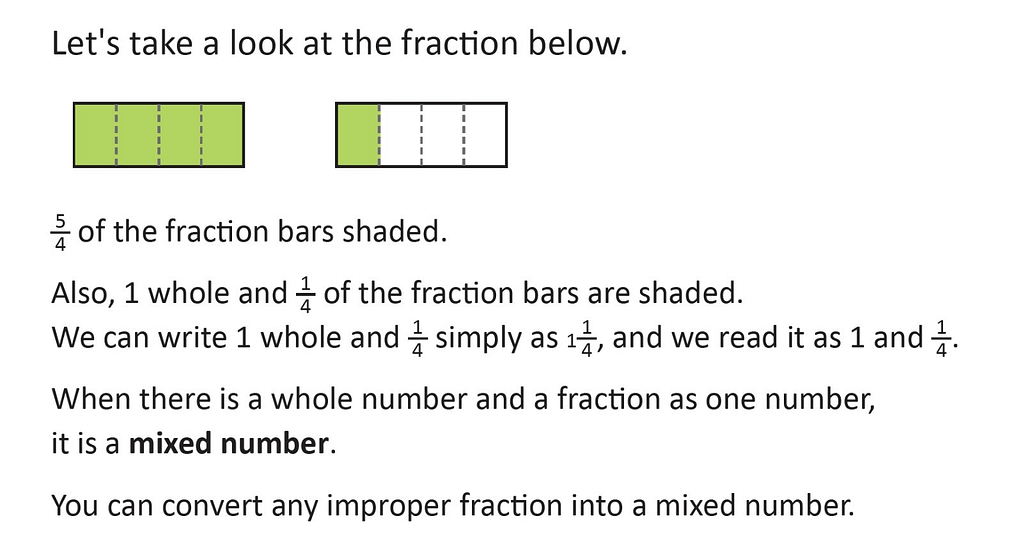
When there is a whole number and a fraction as one number, it is a mixed number.ย 

Take a look at the fraction below.

fraction

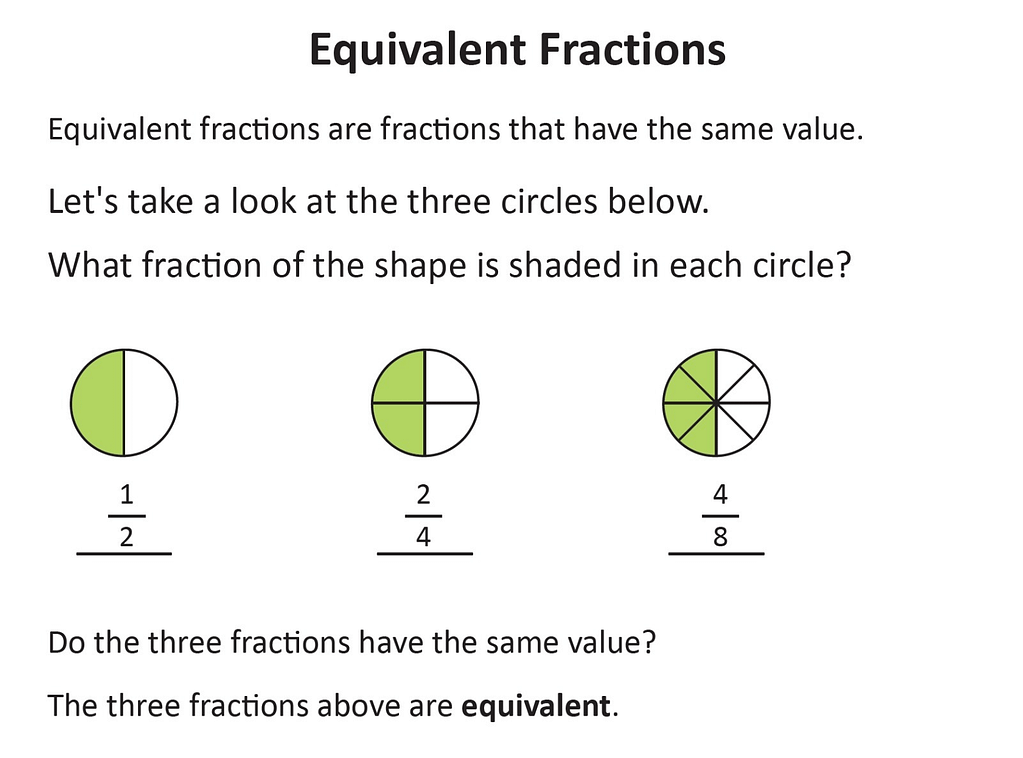
equivalent fractions

Visualizing Fractions

Using Models:

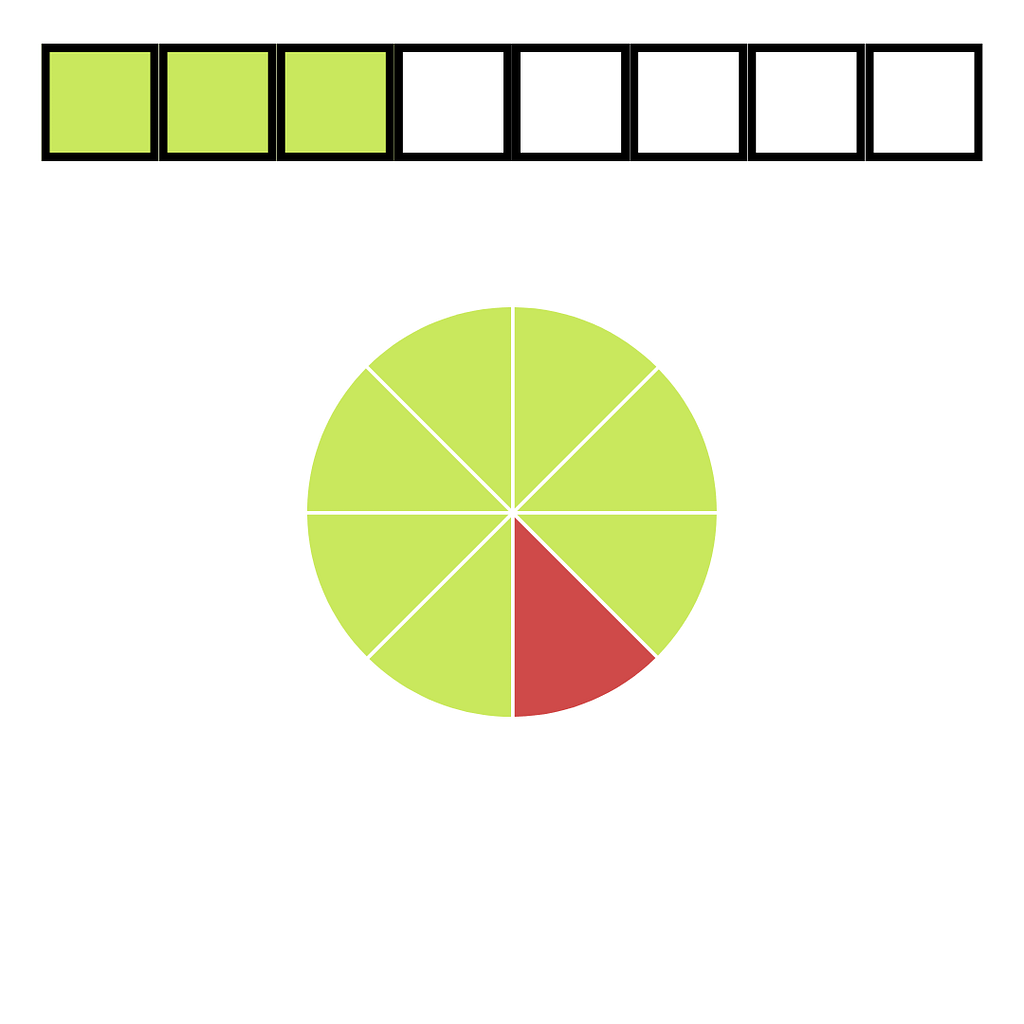
Fraction Bars: Divide a rectangle or bar into equal parts and shade the parts representing the fraction. For example, for , shade 3 out of 8 equal parts of the bar.

Circles: Divide a circle into equal sectors and shade the sectors representing the fraction.

fraction graph 4

Adding and Subtracting Like Fractions

Like Fractions:

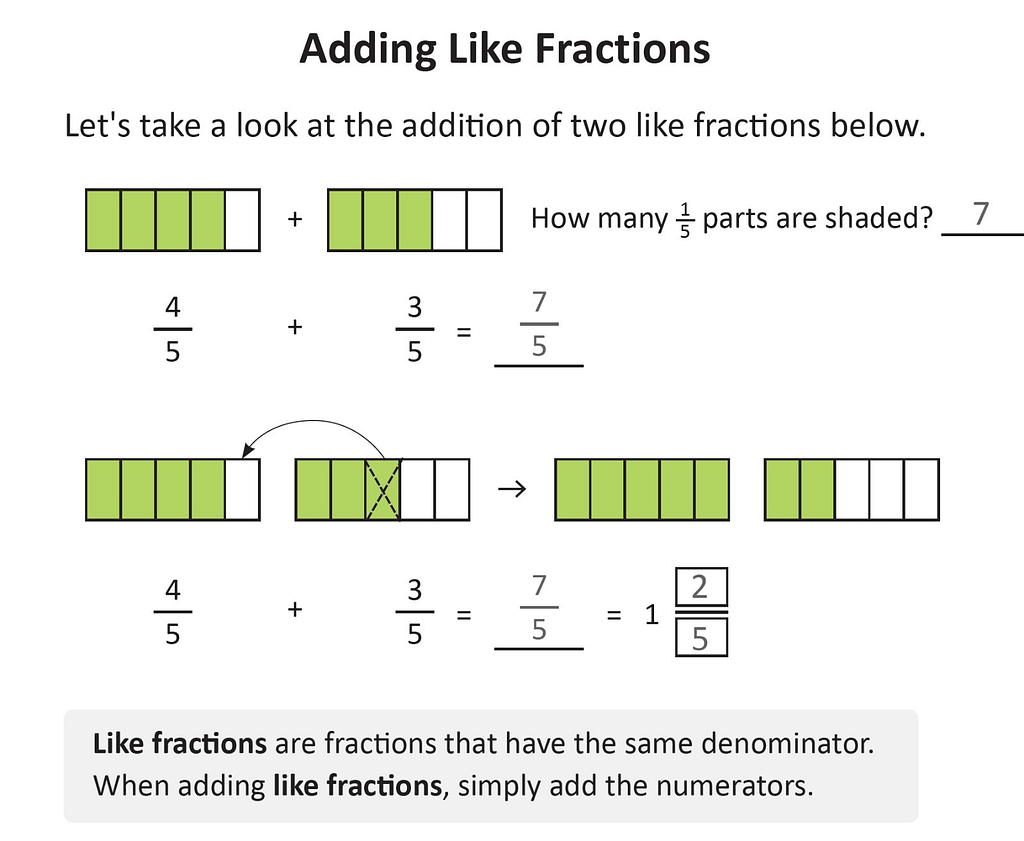
Like fractions are fractions that have the same denominator. When adding or subtracting like fractions, simply add or subtract the numerators while keeping the denominator unchanged. For example, ย + ย = .

Adding and Subtracting Like Fractions

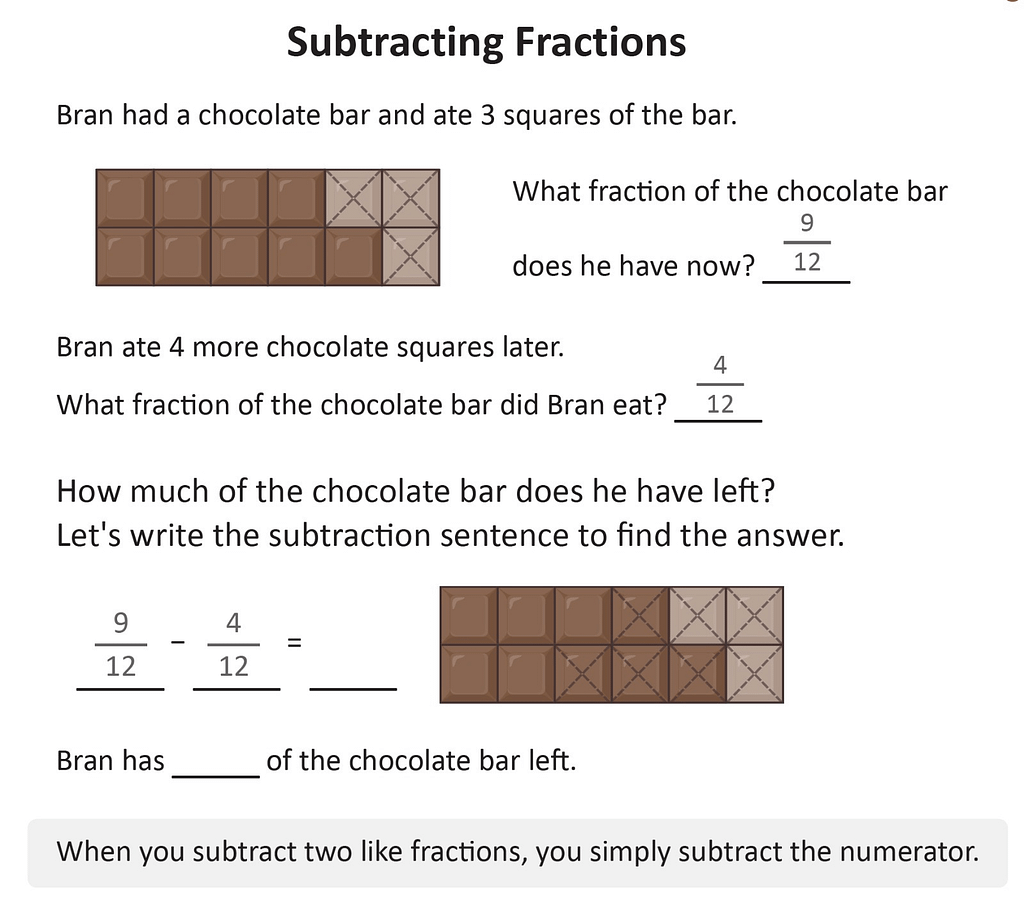
Now, letโ€™s take a look at how we can subtract like fractions.

Suppose Bran had a chocolate bar and ate 3 squares of the bar.

fraction graph

Bran has ย of the chocolate bar left.

Again, when you subtract two like fractions, you simply subtract the numerator and keep the denominator unchanged.

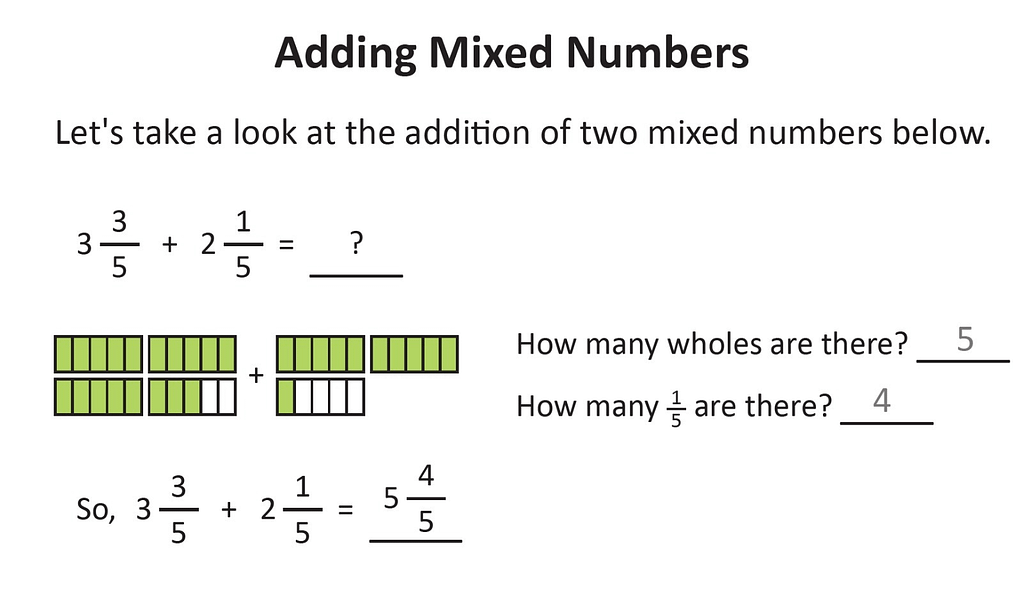
Letโ€™s dig a bit deeper! How do we add or subtract mixed numbers?

Letโ€™s take a look at the addition of two mixed numbers below.

fraction graph 8

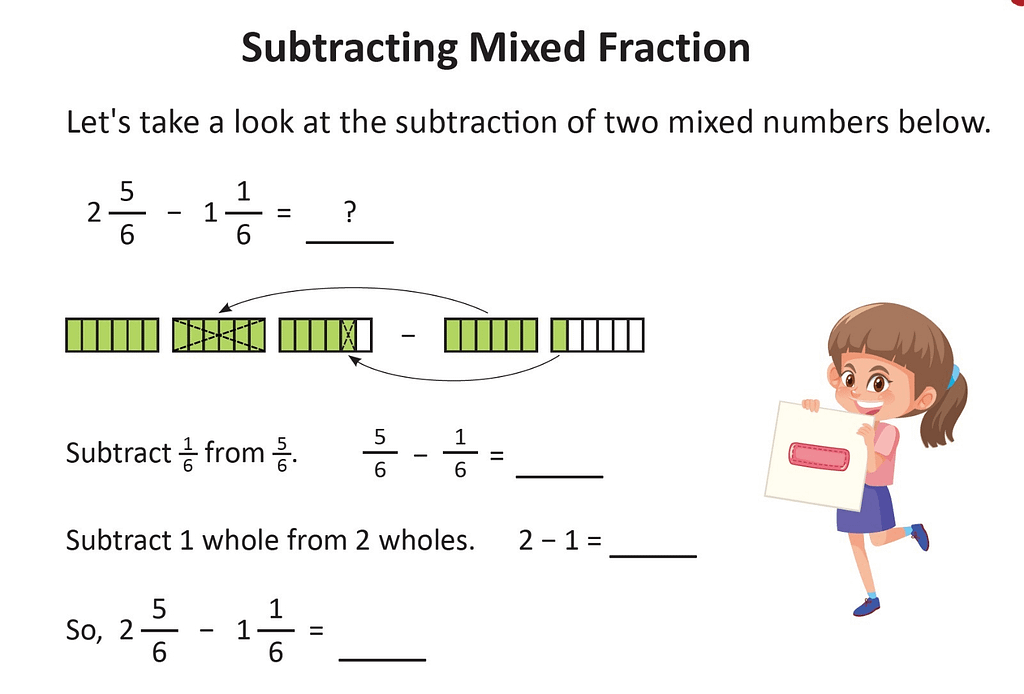
Now, letโ€™s take a look at the subtraction of two mixed numbers below.

fraction graph

Practice Makes Perfect!

  • Solve practice problems regularly to solidify your understanding of fractions.
  • Use online resources, games, and apps to make learning more engaging.
  • Feel free to seek assistance from teachers, tutors, or classmates without hesitation.

By following these steps and consistently practicing, you can master elementary fractions and build a strong foundation for future mathematical learning. Remember, patience, perseverance, and a positive attitude are key!

Need help with elementary Math? Reach out to the PALS Learning Center today!

Building Foundations: PALS Curriculum in Math and English

Building Foundations: PALS Curriculum in Math and English

Math and English are usually the subjects where many students struggle. If your child is having a hard time, you can offer the support they need by signing them up for our math and English tutoring programs. At PALS Learning Center, we offer custom elementary English andย elementary math tutoringย inย Edison to help students enhance their performance and attain academic excellence. Moreover, our personalized tutoring features a comprehensive curriculum aligned with Common Core standards. This way, you donโ€™t have to find different tutoring centers to enrich your childโ€™s learning.

About our English program

PALS English program exposes young learners to challenging reading texts, including a range of nonfiction, fiction, speech, drama, and poetry. However, we go beyond reading by providing structured lessons in reading and language strategies. We recommend our curriculum to students in the early grades to help them master reading and writing simple sentences and words. As students progress, they will be introduced to challenging texts with questions to hone their reading comprehension skills. With our expert teachers, we commit ourselves to helping your child excel in language and reading.

About our math program

Our approach to elementary math tutoring in Edison is unique from other tutorial centers in the area. PALS Math is aligned with NJ Common Core to ensure a modern curriculum that helps students boost academic excellence and performance. Our tutors are focused on enhancing your childโ€™s conceptual understanding, problem-solving skills, and proficiency with numbers. This way, your child can have a stronger foundation on the subject.

For advanced students, ourย elementary math tutoringย inย Edisonย allows them to navigate challenging word problems with confidence. Rest assured that every essential skill we teach in each grade is delivered in small, easy-to-understand steps. Plus, our weekly progress is based on the skills our students learn from the previous weeks, so they can retain what they already know while learning new skills. This way, we hope to motivate learners and build their confidence.

Boost your childโ€™s confidence in math and English by enrolling them in our programs. Call +1 732 777 7997 to learn more about our English andย elementary math tutoringย inย Edison. You may also schedule an appointment at a PALS Learning Center near you here on our website.

Helping Your Child Master Math

algebra-2

Helping Your Child Master Math from Elementary to High School

Math is a core subject taught in every grade, from elementary school to high school. It can be difficult for parents and students alike to keep up with the changing curriculums as each grade level advances. In this blog post, weโ€™ll go over what math topics your child will learn in middle and high school, as well as some tips on how you can help them navigate through the different courses.

Math Topics in Middle and High School

At the middle school level, your child will likely begin taking pre-algebra classes. Pre-algebra focuses on teaching students to think abstractly by introducing different types of equations that involve variables. This is also when theyโ€™ll start learning basic concepts such as fractions, decimals, and ratios. At this stage, itโ€™s important for parents to make sure their child has a good grasp of these concepts before moving onto more advanced material.
PALS Learning Center

In high school, your child will likely take four math classes:

Algebra 1, Geometry, Algebra 2, and Pre-Calculus (or Calculus if they’re super advanced). Algebra 1 covers linear equations and functions; geometry deals with shapes and angles; Algebra 2 focuses on quadratic equations and polynomials; and Pre-Calculus introduces trigonometry and exponential functions. All of these classes are essential building blocks for higher-level mathematics such as Calculus. While the PSAT 8/9 test isn’t mandatory for all students (it’s typically only required of incoming 8th graders), it can be a helpful tool for assessing your child’s knowledge of basic math principles like addition / subtraction / multiplication / division, algebraic equations and problem solving skills.
PALS Learning Center

Tips for Helping Your Child With Math

  1. Encourage practice โ€“ One of the best ways to ensure that your child understands the material theyโ€™re learning is to have them practice regularly. This could be anything from doing review problems at home or having them do online practice tests like those offered by Khan Academy.
  2. Break down complex problems โ€“ If your child is having trouble understanding a certain concept or problem set, try breaking it down into smaller chunks that are more easily digestible for them. This helps break up the monotony of tackling one big problem all at once and allows them to focus on one specific area at a time.
  3. Make use of online resources โ€“ There are plenty of great online resources available these days that can help supplement traditional classroom instruction. Sites like Khan Academy offer free tutorials on various math topics and interactive practice questions tailored specifically to each studentโ€™s skill level so they can work at their own pace.
PALS Learning Center
Regardless of whether you have a budding mathematician or someone who struggles with math in the family, it is always important for parents to stay informed about what their children are learning in school so that they can provide support where needed. Understanding what topics are covered during middle and high school math classes will help both parents and students manage expectations better when preparing for tests or advancing further into higher levels of mathematics education later on in life. With some consistent effort spent practicing course material at home along with utilizing helpful online resources like Khan Academy when needed, there’s no reason why any student can’t excel in mathematics!